Thursday, January 10, 2008

Book Report: Out of Body


Written by screenwriter and producer Thomas Baum, 'Out of Body' is one suspense novel that I thoroughly enjoyed. I bought it to see if anything could be learned in regards to my own story, which deals with writing not-so-believable things happening in a believable way. I was not disappointed.

'As the story begins, Denton Hake is released from prison, having served his time for a rape he cannot believe he committed. While living with his brother and trying to start over, a new girlfriend is found murdered and Hake, the logical suspect, goes on trial for his life. He loses periods of time, a dissociation sometimes found in survivors of childhood trauma. His therapist tries to help him understand the lapses and their connection to his father's mysterious death, while a new wrinkle sets in. Now he can leave his body and witness events in other locations. Fearing for his sanity, he starts to believe that he might be violent while in these fugue states.'

First sentence: "Five minutes into my parole hearing, despite all Carl Williams's warnings, I started to drift."

Drifting is what this story does best. This story moves at lightening speed, composed of copious amounts of dialogue and mere flashes of physical transition. In the beginning, I faulted the author for being *too* brief, but quickly realized the 'blink-and-you-miss-it' actions are part of Denton's character. He blacks out, starting for only seconds at a time, enough to appear to be daydreaming or retarded. But as the story progresses, not only to the blackouts get longer, but Denton also seems to seperate from his body and view things in one place while his body, on auto-pilot, remains stationary. As he comes back to his physical self, Denton has no recollection of conversations, poker games, or anything else he was 'really' doing. Instead, he's seen where his sister in-law has hidden her bottle of vodka, or who his girlfriend is sleeping with behind his back. These 'out of body' experiences soon have him with only a small handful of friends, and even those think he's crazy.

It's easy to get into the flow of Denton's visions, and for such a complex, daunting plot, first-time novelist Baum weaves quite a razor-sharp, razor-smooth story. Each character is unique, the plot tight, the realism heavy. The characters are smart, and the scenes between Denton and his therapist are cutting and thought-provoking. The climax ping-pongs between a tense courtroom scene and the release of long-buried memories, creating a surprise ending I never saw coming. This is a tight, whirl-wind of a novel--the kind of story that ventures everywhere you want and skims the parts of little importance. Very easy to read in one sitting.

Five out of five stars for so flawlessly weaving together the supernatural and the 'real world', and for simultaneously keeping both feet anchored on the ground.

Book Report: The Rules of Survival


Authored by Edgar Award Winner Nancy Werlin, this story is in the same vein as 'A Child Called It', but much less graphic/physical abuse and much more emotional mind games. Written in first-person 'memoir style' by teenaged 'Matt Walsh', it is hard to see how the events that take place could possibly lead to a happy ending.

'Living with an unpredictable, psychotic mother has taught Matthew how to survive. Constantly on alert, he and his sister, Callie, devotedly shelter their younger stepsister, Emmy, from their mother's abuse and worry about staying safe. Matt insists that "fear isn't actually a bad thing . . . . It warns you to pay attention, because you're in danger. It tells you to do something, to act, to save yourself," but his terror is palpable in this haunting, powerful portrayal of domestic dysfunction, which is written in retrospect as a letter from Matt to Emmy. Unfortunately, the adults in the children's life, a distant father and an apathetic aunt, don't help, though Matt sees a spark of hope in Murdoch, who dates his mother, Nikki, and then leaves when he becomes another target for her escalating rage. It is Murdoch, with a violent past of his own, who is willing to risk getting involved and eventually becomes the change agent that the children so desperately need.'

First sentence: "For me, the story begins with Murdoch McIlvane."

The story opens when Matt and Callie go into a small convince store and witness a stranger, Murdoch, standing up for a little boy whose when his father becomes violent. To Matt, Murdoch becomes a nameless Superhero, one he spends all his free time for the next year trying to find. Then as a birthday present, Matt's sister Callie finds Murdoch's address in the phone book. But before they can visit, Matt's mother finds the address and assumes her children at trying to set her up on a date. Dragging all three children, she goes to Murdoch's house, introduces herself, and that easily Murdoch becomes the best friend Matt always wanted.

But things don't stay that way for long. Matt's mother seems to have some variety of psychosis, and when her true self is revealed to Murdoch, the fantasy-family falls apart. Nikki grows more and more violent, out of control, and soon focuses all her attention on stalking Murdoch and even accuses him of beating her. While Matt is used to this sort of unpredictable behavior, he finds himself without Murdoch's friendship and so turns to other people for help.

The price sticker on this book says it's categorized as 'teen fiction', and while the writing itself suits a younger audience, the events and emotions will resonate with any aged-reader. Matt is a very 'deep' character, one who observes and thinks far beyond what he actually says. There is a maturity to him that lends to his situation and creates sympathy. This story is very much about transformation, salvation, and understanding the evil that lurks inside us all. I enjoyed Murdoch's character too, and the ending feels like a missing piece of the puzzle that goes beyond the depth of what simplistic 'teen fiction' is composed of. I enjoyed this fast paced story and it's bite-sized chapters, and I found Matt's journey and the things he realized about himself fascinating and real.

The Rules of Survival begins and ends with Murdoch McIlvane, a supporting character who is a powerful, mysterious catalyst for both the protag and the story itself.

Five out of five stars for mastering human emotions and creating characters to learn from

Friday, January 4, 2008

Book Report: The Kings of Infinite Space


'According to Paul Trilby, there's something weird going on at the Texas Department of General Services, where he slaves away as the lowliest-of-lowly corporate workers, the office temp. Of course, Paul also thinks his apartment is haunted by the ghost of his ex-wife's cat, and that egg-headed aliens wearing pocket protectors are stalking his daily commute. Yes, ol' Paul's grasp on reality is none too secure, but that's understandable. Divorced, destitute, and driving a rattletrap clunker amidst a sea of sleek SUVs, Paul's down-and-out existence is a far cry from his former glory days as an up-and-coming university professor. Confronted by his smarmy co-workers (who are not above selling their souls for a better gig), Paul is introduced to a mysterious world of former employees, equally downtrodden middlemen downsized in state budget cuts. The only difference is--they're dead. In the best tradition of Baum, Carroll, and Orwell, James Hynes crafts a mordantly incisive satire on a corporate America where incompetence is rewarded and talent ignored.'

First sentence:
"One brutally hot summer's morning, Paul Trilby--ex-husband, temp typist, cat murderer--slouched sweating in his t-shirt on his way to work, waiting behind the wheel of his car for the longest red light in central Texas."

James Hynes had me hooked on 'Kings' half-way through the first line. This book is visual, fun, hilarious and creepy in all the best ways. It reads much like a movie, with action scenes clearly depicted and each character unique and recognizable. Except for the occasional weirdness, much of this story resembles the movie 'Office Space', but maybe even a little better.

I loved the first few incidents where Paul begins to question his sanity:
"He pushed the book away and pressed his fingers into his eyes, and when he pulled them away he saw a string dangling from the ceiling fifteen feet away. Paul squeezed his eyes shut, then looked again. The string was still there, hanging over a lunchroom table straight as a plumb line, suspended from a little, black, triangular gap where a ceiling panel was askew. At the lower end of the string a little noose was being raised and lowered over a salt shaker in the middle of the table. The noose draped once over the shaker without catching it, then twice, then again, the string above slackening each time. Then, one more try and it caught around the neck of the salt shaker. The string went taut, and the salt shaker swung silently up off the table."
What I loved about this was that immediately after, another character approaches Paul and he never really gets to reflect on what just happened. That left me sitting there with a delicious 'WTF?' grin, and had me racing on to find out more.

I'm sure the repetitive use of the word 'bloodless' was meant to be a motif or a clue, and it was a noticeable one. Every time I read it, it threw me out of the story as I pondered it.

I've never before read a novel that so completely jumped genres. This story cruises along as a lovely comedy, the humor both in witty dialogue and situations. But the climax switches gears completely, and as the reader is taken into a world that could easily be interpreted as Hell, the wit falls away and Hynes concentrates instead on describing his underground world. But he executes a rather complicated, fast-paced chase scene which serves to answer all the questions and also raise a couple more. Paul's future is left uncertain at the end, but you will find one of the best last sentences ever.

Four and a half stars out of five, for originality and addictiveness, and because work really is Hell.

Book Report: Grand and Humble


This fast-paced little novel by Brent Hartinger tells the tales of two boys, Manny and Harlan, who seem to have opposite lives. In alternating chapters, Hartinger introduces two high-school kids who seem to be worlds apart. Harlan, 17, the gorgeous, brilliant son of a rich senator, appears to have it all; he never notices that his dad is always busy or that his mom is a control freak. Manny, also 17, is a theater geek, the child of a poor, nurturing single-parent dad, who has secrets that he won't share with his son. But the boys are alike in at least one way: both have panic attacks and recurring nightmares about drowning and being hit by a truck. Harlan's battle with his demonic mother is too purposive (his panic attacks will stop if he stands up to her), and readers may be confused about who's dreaming what until the plot cleverly twists to reveal a surprise.

The minor characters are nicely drawn, including Harlan's best friend, Ricky, who is gay. Manny's best friend, Elsa, is deaf, and their signing talk is relaxed and friendly. This story reads simply and is in fact rated for grades 7-10, making this a fast weekend read. While not of outstanding quality, I read till the end, wanting to know the 'big secret'. While a little predictable--or at least, guessable--it forces the reader to stop and reevaluate, to question everything that happened before.

While not completely original, Hartinger avoided cliches where he could and it shows. Good, solid writing.
Three out of five stars

Friday, December 7, 2007

Book Report: Car Trouble


Another Cargo Largo bargain bin find: Car Trouble by Jeanne DuPrau.

"Recent high-school grad and computer-whiz Duff Pringle is on a cross-country road trip, headed from home in Richmond, Virginia, to a California job designing the next-generation something or other for a company that modestly calls itself "Incredibility, Inc." Alas, real life doesn't run as smoothly as a computer program, and, in short order, Duff's battered old Ford breaks down, he meets a fast-talking hitchhiker in a wild shirt, loses his wallet in a scary biker restaurant, finds himself stranded in St. Louis, and, well, that's just the tip of an iceberg of troubles."


I picked this up because it promised of interesting characters, and I wasn't disappointed. This was an easy read, and at times thought-provoking, with simple imagery and a predictable plot. But it was fun, fast, wrapped up nicely. Nothing outstanding, but still a good time.
Three out of five stars.

Thursday, December 6, 2007

Book Report: The Bang Devils


Found this novel by Patrick Foss in good old Cargo Largo--the cheapskate's bargin bin--and picked it up based on my old rule of three: Interesting Title, Interesting Cover, Interesting Plot. Oh, and I think I actually read the first sentence, too.

I was hesitant because the book is set in Japan, and I know nothing of other countries or time periods, but curiosity won out and I started reading it the very next day. Three days later, I was cursing the ending. (But in the way I cursed the end of the first Lord of the Rings movie. You know, when you get invested in something and you want more.)

Book Description
If you commit a crime and nobody catches you -- is it really wrong?

For Chris Ryan and Jessica Romano, two Americans living in Japan, life is like a movie. Money comes easy when you're an "exotic" Westerner. Sex comes even easier. With every need instantly satisfied, the greatest worry is growing restless. Because when your life is a movie, it doesn't take long before you decide you need to do something ... cinematic.

So when a wealthy Japanese businessman, overcome with too much whiskey -- and too much Jessica -- boasts that he secretly keeps a fortune in cash in his home, Jessica enlists Chris and her boyfriend, Taro, to help her execute the perfect kidnapping. But they soon learn that the money might not be the only secret the businessman is keeping.

As the stakes start to rise, the three friends begin to question their motives -- and one another. It doesn't take long for them to realize that while the surest way to survive is sticking together, the surest way to get rich is betrayal.


The front-page praise for this book was another selling point for me: When I read about the 'graphic pop violence', I knew I was taking it home. And graphic it was, not nearly the worst I've ever read, but indeed graphic and messy. This story drives ahead and never stops to breathe, least not for more than a few pages at a time, but the action alternates between mental and physical in a way that ensures no one gets lost or drops out. I appreciated the very 'movie-like' style of storytelling, the flashy action and predictable scenes and cookie-cutter characters, with just a hint of sneaky plot twists. This story was very easy to visualize, and it makes me think it is targeted toward a younger audience, although not labeled as such.

However it seems as though all of Floss's creativity went into the scenery. I got a feel for Japan, especially the night life and the richer, sexier side of it all. But his characters were lacking. Chris could easily be played by the 'Sexiest Male Actor of the Minute', as he was all about cunning and flashiness. Jessica was over-feminized to the point of annoying--the classic blubbering blonde in any given slasher movie. And the third guy? Well, the fact that I've forgotten his name should be enough evidence.

Great idea, great twist on a tired-but-true plot, and 'Bang Devils' certainly had its moments and one-liners. But overall, the title impressed me more than the characters.
Three out of five stars.

Monday, December 3, 2007

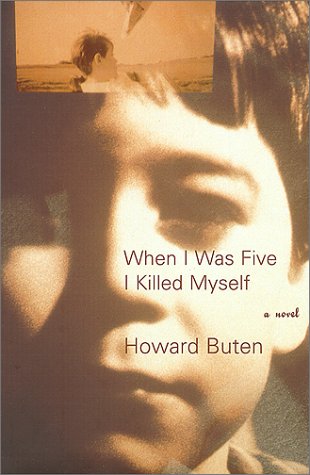
Book Report: When I Was Five I Killed Myself


This novel by Howard Buten is one of the most complex and emotionally charged stories I've read.

"Burton Rembrandt is placed in the Children's Trust Residence Center, an institution for disturbed, psychopathic or autistic children, following an inappropriate amorous encounter with female classmate Jessica. Told in Burt's precocious voice, the story is supposedly written by the boy in pencil on the walls of the Quiet Room. It is a compelling study of the tragedy that can result when literal-minded children and literal-minded adults fail to understand each other. The adults (parents and psychiatrists alike) take little responsibility for the misinformation they spout while they narrowly interpret as sociopathology Burt's innocent comments, normal for any child, about his "hate" or his desire to "kill" something. Wrongly incarcerated with autistic and truly sociopathic children, it is not until Burt encounters a sympathetic psychiatric resident that hope begins to grow, both in Burt and the reader, that the boy will finally be seen for what he is: a child who has a right to an ordinary life."

Despite the front jacket's claim that Burt is misunderstood, I still found myself unsettled by this character. I don't remember having such violent thoughts when I was little, and I'm sure that any child who did even today would be placed in a facility as Burt was. Much of Burt's mannerisms were adopted from those around him: his older brother, his parents, his friends. He often uses words he doesn't understand. His imagination is hyper-active. Buten captured a child's voice with uncanny grace, but I felt like something is lurking on the pages, just beneath my understanding. I feel like I need to be told the answer, like I should talk with other people who have read the book so they can explain it to me. I enjoyed it, I really did, but I think it warrants a second read-through to unlock those deeper layers.
A trademark of a great story? I think so.
Five out of five stars